 Matunion
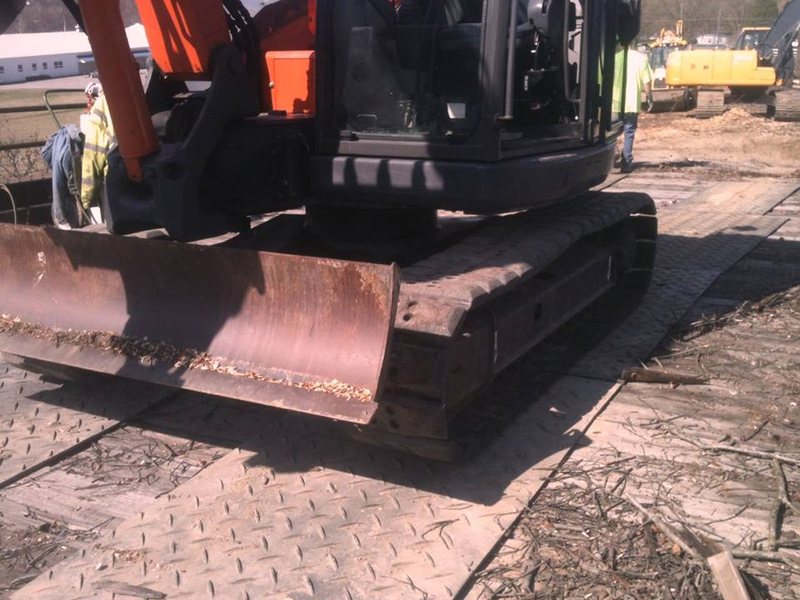
A track mat keeps plant moving over ground that would otherwise rut, sink or be damaged. Track mats for sale come in four material families — rubber, polyethylene (HDPE and UHMWPE), composite and wood — and the choice changes almost everything that follows: weight, grip, load behaviour, cleaning method, service life and freight.
Matunion supplies HDPE (high-density polyethylene) and UHMWPE (ultra-high-molecular-weight polyethylene) ground protection mats. We do not supply rubber, composite, wood or steel track mats, so this guide compares the main product types, sets out where each one fits, and is straightforward about where we are not the right supplier for you.
The material decision comes before the supplier decision. Get it wrong and a competitive quote is still a quote for the wrong product.
Track Mats for Sale: Types and Use Cases
Track mats for sale are used in two related ways. The first is a heavy running surface for tracked plant — excavators, dozers, compact track loaders — on a haul route, crossing or compound. The second is a lighter temporary trackway for wheeled vehicles, pedestrians and events over turf or finished surfaces. The same term covers both, so establish which one a supplier is quoting.
Material options
Rubber. Many moulded rubber track mats are made from recycled tyre rubber, usually with interlocking tabs or connectors. Rubber is dense, so a rubber mat is heavy for its footprint. Grip is the strength: rubber holds well wet or dry, and it deadens noise and cushions impact. That is why rubber is common in event flooring, pedestrian walkways and turf protection. The trade-offs are weight, cleaning and heat. Mud and oil sit in the surface texture, and long UV exposure oxidises the surface, so the rubber can harden and become more prone to cracking as it ages. Many rubber products are sold without a panel load table, so ask for one if the mat will carry plant.
HDPE. Among plastic ground protection track mats, high-density polyethylene is the default. A 4×8 ft, 12.7 mm HDPE ground protection mat weighs 38–42 kg, so two workers can place it without a machine. The double-sided diamond tread gives grip, six handholds make it manageable, and connectors hold a run together. HDPE absorbs no water, does not rot and is recyclable. It spends its life outdoors, so check the UV package.
UHMWPE. Ultra-high-molecular-weight polyethylene is the same family with much longer polymer chains. It offers better wear resistance and a higher load at its specified thickness: over 600 t static against over 200 t static for standard HDPE, per our client datasheet. These are static ratings on firm competent ground for a defined thickness and size, not general capacities. It is heavier and more expensive, so it earns its place on heavily used haul routes, abrasive ground and tracked plant rather than on occasional access. Our material comparison covers the property differences.
Composite. Composite track mats are engineered panels, often a fibre-reinforced polymer over a structural core. They are built for stiffness and heavy loads, and load ratings are panel-specific, so ask for the load table that matches the panel, thickness and support conditions. They typically cost more per square metre than HDPE and are harder to repair: a cracked or delaminated panel usually has to be replaced.
Wood. Timber mats remain common for crane matting and temporary roads in some regions. They are heavy, absorb water and rot, and solid-timber products can face phytosanitary import conditions in some markets, separate from the ISPM 15 rules for wood packaging. Matunion does not supply them.
| Property | Rubber | HDPE | UHMWPE | Composite | Wood |
|---|---|---|---|---|---|
| Base material | Recycled tyre rubber | Virgin HDPE | UHMWPE | Fibre-reinforced polymer | Hardwood |
| Weight for footprint | High | Low | Medium-high | Medium | High |
| Grip when wet | High | Good with tread | Good with tread | Medium | Low to medium |
| Water absorption | Low; texture traps dirt | Zero | Zero | Low | High |
| Published load table | Often none | Yes, static basis | Yes, static basis | Panel-specific | Varies |
| Cleaning | Harder | Easy | Easy | Medium | Medium |
| UV and ageing | Can harden and crack | UV-stabilised | UV-stabilised | Resin-dependent | Rots |
| Recyclability | Downcycled | Recyclable | Recyclable | Limited | Landfill or burn |
| Typical use | Turf, events, pedestrian, light plant | Site access, haul routes | Tracked plant, abrasive ground | Heavy engineered crossings | Crane matting, temporary roads |
| Matunion supplies | No | Yes | Yes | No | No |
The table compares general material behaviour, not specific products. Ask each supplier for the panel data behind their claim.
The phrase heavy duty track mats means little without a material and a load capacity statement. Heavy duty rubber, heavy duty HDPE and heavy duty composite are three different engineering terms.
Standard sizes and thickness
Track mats sizes follow the conventions of ground protection mats. The 4×8 ft panel — 1220×2440 mm, 2.98 m² — is the standard for polyethylene. Matunion also supplies 3×8, 2×8, 3×6, 2×6 and 2×4 ft panels and custom sizes. Rubber and composite panels come in their own footprints, and some are in metric units, so convert every quote to price per square metre before comparing.
Thickness drives both weight and load. The standard HDPE section is 12.7 mm at 38–42 kg per mat; heavier duty uses a thicker section or switches to ultra-high-molecular-weight polyethylene (UHMWPE). Confirm the thickness-to-load pairing in writing rather than inferring it from the material name.
A 100 m single-lane track, two mats wide, needs about 41 rows of 2.44 m mats — about 82 mats in total before cuts and overlaps. At 38–42 kg each, that is a little over 3 t of matting. Allow extra panels for cuts, damaged panels and laying at both ends of the route.
Application fit
| Job | First choice | Why | Watch |
|---|---|---|---|
| Haul route for a tracked excavator | HDPE or UHMWPE | Light, interlocking, textured | Confirm the load rating for your machine and ground |
| Track mats for heavy equipment on abrasive rock | UHMWPE or composite | Wear resistance, stiffness | Ask for the load table |
| Turf protection for an event | Rubber or HDPE | Grip and load spreading | Rubber is heavy and harder to clean |
| Pedestrian walkway | Rubber | Grip, comfort, quiet | Weight, cleaning, UV ageing |
| Wheeled delivery vehicles over lawn | HDPE | Load spreading at low weight | Short duration only |
| Long-term outdoor yard | HDPE or UHMWPE | UV-stabilised, no rot | Drainage and edge support |
| Crane crossing or extreme point load | Composite or steel | Stiffness | Not a Matunion product |
Connectors decide whether a track stays a track. Check compatibility with mats you already own, and ask for a connector sample before the order.
Price Factors and Quote Comparison
Track mats price is usually quoted per mat. The useful number is per square metre of running surface, delivered to site, because panel sizes differ between materials.
Material, thickness and size
Material is usually the largest driver. Rubber is dense, so the same footprint uses more raw material and weighs more. Composite panels carry an engineering premium, and UHMWPE sits above HDPE. Thickness and panel size scale material use directly: a 4×8 ft panel uses four times the resin of a 2×4 ft panel at the same thickness. Surface pattern, connectors, colour and UV package add at the margin. Volume has a large effect on unit price, which is why MOQ belongs in the comparison.
Freight, duty and container loading
Weight drives freight. Rubber and wood are heavy for their area; HDPE is light. In a container shipment the difference shows up twice: in the freight rate and in how many panels fit before the container reaches its weight limit.
For 12.7 mm HDPE, the number of mats per container depends on the surface pattern and thickness: single-sided and double-sided treads load differently. Heavier materials fit fewer panels by weight even when floor area is available, so ask for a loading plan in both panels and tonnes. Standard export packing for 4x8 ground protection mats is palletised and strapped, which adds height and weight. Standard sizes ship in 7–15 days and custom orders in 15–25 days.
Duty depends on HS classification and destination, and it changes. Confirm the code and rate with your customs broker rather than relying on a supplier's estimate. Plastic mats are not wood, so ISPM-15 treatment does not apply to the mat itself, but in the EU, the US, Australia and New Zealand wooden pallets, crates and dunnage still need compliant ISPM 15 marking on debarked wood. Our shipping notes cover Incoterms and packaging.
What a complete quote should include
A comparable track mats supplier quote puts the same fields in the same order. Use this table to normalize quotes before comparing totals.
| Quote field | What to check | Why it matters |
|---|---|---|
| Material and grade | Polymer grade, rubber source, composite build | "Rubber" and "HDPE" are not specifications |
| Panel size and coverage | Length, width, area in m² | A cheap panel can be a small panel |
| Thickness and unit weight | Both, per panel | Weight drives freight and handling |
| Load basis | Static/dynamic, size, ground, duration | Tonnage without a basis is not comparable |
| Surface and wet grip | Tread type, pattern depth | Grip changes with water, mud and ice |
| Water, oil and chemical resistance | Absorption, cleaning method | Affects life and labour |
| UV package and expected life | Stabiliser, warranty | Cheap UV packages fade and crack |
| Connector system | Type, number, compatibility | Weak joints slow installation |
| MOQ, lead time, sample policy | Written, by material and size | Schedule and trial-order risk |
| Incoterm, port and validity | FOB/CIF/DDP, named port | Hidden freight and port charges |
Inspection and Acceptance
Sample vs bulk
Ask for a production sample from the line that will make the order, not a hand-made one. Confirm the line and the material batch. For rubber, check for cracks, hard spots and separation between layers. For composite, check edges for fibre exposure and impact damage. For HDPE, check thickness, flatness, tread and handholds.
Ask the supplier to retain a production sample and to put batch numbers on the packing list. If colour, thickness or surface changes later, you have a reference.
Dimensions, weight and surface
Measure the sample and, for container orders, the pre-shipment lots:
- thickness at several points, especially the centre and edges;
- length, width and squareness;
- unit weight against the quotation;
- tread depth and pattern consistency on both faces;
- handholds and edge quality;
- connector fit, including against mats you already own;
- colour against the approved standard.
Most defects are visible before loading. Photos and video of the inspection are evidence; "we check visually" is a promise.
Test report matching
A test report is only evidence if it matches the product. Check the report number, the product or model, the test item and the date. Our SGS reports are SHIN2112090776MR-01, QDIN2408001532PL01_EN and QDIN2408001532PL02, with SHAPH25016759501 for RoHS and SHAPH25016759503 for EN71.3. Ask for the full PDFs and confirm they cover the panel you are buying.
CE certificate available on request. If a supplier displays an ISO 9001 mark, ask for the certificate, the scope and the legal entity. A certificate that names another company, or covers another product, is not evidence for your order. Our safety and compliance page explains the standards that do apply.
Supplier Checklist
10 questions to ask
| # | Question | What a good answer looks like | Red flag |
|---|---|---|---|
| 1 | What material and grade exactly? | Polymer grade, rubber source, composite build | "Rubber" or "plastic" only |
| 2 | What is the load basis and test method? | Static/dynamic, size, ground, duration | Bare tonnage |
| 3 | What are the panel dimensions and unit weight? | Written, in mm and kg | Weight not stated |
| 4 | How does it grip when wet? | Tread description and test | Smooth surface sold for plant |
| 5 | Does it absorb water, oil or chemicals? | Absorption and cleaning data | "Easy to clean" only |
| 6 | What UV package and expected life? | Stabiliser, warranty, field data | No UV statement |
| 7 | What connector system? | Type, drawing, sample | "Compatible" with no sample |
| 8 | Which test reports match this product? | Full PDF, matching model | Expired or mismatched report |
| 9 | MOQ, lead time and sample policy? | Written, by material and size | Verbal only |
| 10 | Incoterms, packaging and container plan? | Written breakdown; panels and tonnes | Lump sum; no loading plan |
Red flags
| Red flag | Why it matters | What to do |
|---|---|---|
| "Heavy duty" with no load table | Not a specification | Ask for the panel test and assumptions |
| Rubber mat sold for tracked plant with no test data | Load behaviour unknown | Request a panel load table or walk away |
| Composite load table for a different panel thickness | Capacity does not transfer | Match the exact panel and thickness |
| Price per mat with no panel size | Small panels look cheap | Convert to price per m² |
| Unit weight missing | Freight and handling cost hidden | Weigh the sample |
| "Recycled" with no grade or percentage | Inconsistent performance | Ask for the material datasheet |
| Connector "compatible" with no sample | Weak joints on site | Request a connector sample |
| "ISO/CE" without a certificate | Unverifiable claim | Ask for the certificate and scope |
When another supplier is a better fit
Matunion supplies HDPE and UHMWPE ground protection mats, used as track mats, in standard and custom sizes. We do not supply rubber, composite, wood or steel mats, we do not hold local stock in your market, and we do not rent mats. If your project needs a rubber event surface, a composite panel for an extreme crossing, a timber crane mat, or same-week local delivery, a specialist or local supplier is the better choice.
What we can do is quote against your route, load and ground, supply a production sample, provide the SGS reports, and ship FOB Qingdao, Shanghai or Ningbo, with CIF or DDP on request. Our buying guide walks through the selection sequence.
Buyer FAQ
What size ground protection mat do I need?
Start with the running width and the heaviest load, then the ground. A 4×8 ft mat covers 2.98 m²; two side by side give an 8 ft running width. Ground protection mat sizes are usually quoted in feet in North America and millimetres elsewhere, so convert before comparing.
How many 4x8 mats fit in a 40ft container?
It depends on the surface pattern and thickness. Single-sided and double-sided tread panels of the same nominal size load differently, and thicker or heavier mats reduce the count because the container reaches its weight limit before the floor area is full. Rubber and composite panels are heavier again, so ask for a loading plan in panels and tonnes.
What is the load capacity of a 4x8 HDPE mat?
Our client datasheet rates HDPE ground protection mats at over 200 t static on firm competent ground. That figure is for a defined thickness and size, and it is a static rating: travel, braking and turning reduce the usable capacity. It is not a universal rating for every 4×8 ft panel or every soil. Ask for the test basis and confirm the thickness-to-load pairing in writing. SGS testing can be arranged on request.
Can ground protection mats be used on grass, gravel or mud?
Yes, with different preparation. On grass, mats protect the surface for short-duration traffic, but the ground still has to drain. On gravel, grade and compact first so the mat does not bridge voids. On mud or saturated clay, a mat spreads load but does not create bearing capacity; expect to need more area or ground improvement.
HDPE vs UHMWPE: which mat is better?
Neither is better in every case. HDPE is lighter and cheaper, and suits general site access, vehicle crossings and turf protection. UHMWPE is heavier and more expensive, with greater wear resistance and a higher static load at comparable thickness and size on firm competent ground; it earns its cost on tracked plant, abrasive ground and repeated heavy use. Decide on load, ground and traffic, not the material name. Our UHMWPE heavy-duty page covers the upgrade case.
Next Step
Send us the route length, running width, heaviest machine and ground condition. With accurate route data, we can calculate the quantity you need. We will tell you whether HDPE or UHMWPE fits, and if neither does, we will say so. The quote will use the same fields as the table above so you can compare it with a rubber or composite quote on equal terms.
CTA: Request a same-basis quote · Request a production sample · Request the track mat selection table · Compare mat materials.
Reviewed by: Matunion Engineering Team
Last updated: 5 November 2026
How we researched this guide: We compared published material behaviour and current supplier listings with our own client datasheets and SGS reports. Load figures are static ratings on firm competent ground for a defined thickness and size, not universal capacities. Rubber, composite and wood comparisons describe general material behaviour; confirm the specific product data with the supplier.