 Matunion
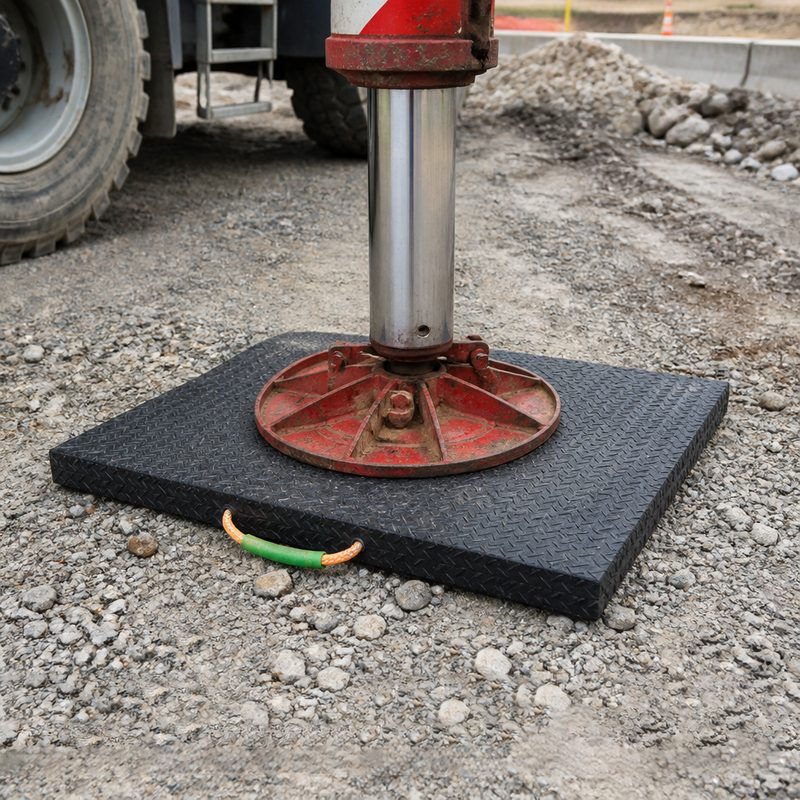
An industrial crane pads supplier can look qualified on a catalogue page. The specification that matters is quieter: the material grade, the basis of the load rating, the test report behind the claim, and what happens when a pad arrives undersized. This guide is a buyer audit for industrial crane pads — outrigger, stabilizer and float pads used under mobile cranes, concrete pumps, fire and rescue vehicles, and utility trucks.
Matunion supplies UHMWPE outrigger pads. We are not a neutral directory, so this guide includes our own audit and when another supplier is a better fit. Use it on us first. The goal is a shortlist you can defend to an engineer, a safety officer and a procurement manager.
Industrial Crane Pads Supplier: Types and Use Cases
Industrial crane pads are not one product. A 300 mm pad under a utility truck and a 1,500 mm pad under a mobile crane share a shape, not an engineering basis. The supplier should explain which one your lift needs.
Material options
| Material | Stiffness and strength | Weight and handling | Water and rot | Load behaviour | Best fit |
|---|---|---|---|---|---|
| UHMWPE | Flexural 50–70 MPa; compressive 40–60 MPa | Light; one or two workers | No absorption, no rot | Spreads load; can creep under sustained load | Crane outriggers, wet ground |
| HDPE | Flexural 30–50 MPa; compressive 30–40 MPa | Similar density to UHMWPE | No absorption, no rot | More flexible than UHMWPE | Mats, lighter pads |
| Timber or plywood | Variable; moisture-dependent | Heavy when wet | Absorbs water; rots and splinters | Stiffness changes with moisture | Low-cost temporary support |
| Steel | High stiffness and strength | Several times heavier | Corrodes without coating | Very stiff; edge concentration | High point loads |
| Aluminum | High strength-to-weight | Lighter than steel | Corrosion-resistant | Can dent; conducts electricity | Portable pads |
Typical reference values; ask for the datasheet for the exact grade.
UHMWPE is the material we use, but it is not right for every site. It is lighter than steel and does not absorb water, which matters when pads are moved by hand and stored outside. Its lower stiffness means thickness must be specified for the load; a thin pad that bends concentrates pressure at the edges.
Standard sizes and thickness
Industrial crane pads sizes run from 300 mm to 1500 mm; custom sizes go up to 2000×1000 mm. Thickness options are 25–100 mm. See the full outrigger pads range for datasheets.
| Shape | Size (mm) | Thickness (mm) | Area (m²) | Typical starting point |
|---|---|---|---|---|
| Square | 300 × 300 | 30–40 | 0.09 | Utility, light stabilizers |
| Square | 400 × 400 | 40 | 0.16 | RV, small plant |
| Square | 500 × 500 | 40–50 | 0.25 | Bucket trucks |
| Square | 600 × 600 | 40–60 | 0.36 | Pumps, medium cranes |
| Square | 800 × 800 | 50–60 | 0.64 | Mobile cranes |
| Square | 1000 × 1000 | 50–80 | 1.00 | Heavy cranes |
| Square | 1200 × 1200 | 60–100 | 1.44 | Large cranes |
| Square | 1500 × 1500 | 100 | 2.25 | Heavy lift |
| Round | 800 | 50–60 | 0.50 | Roll into place |
| Round | 900 | 50–60 | 0.64 | Medium cranes |
| Round | 1000 | 60–80 | 0.79 | Heavy cranes |
| Round | 1200 | 60–80 | 1.13 | Large cranes |
| Round | 1500 | 100 | 1.77 | Heavy lift |
Square areas from client data; round areas calculated. Standard outrigger pad sizes; the starting point is not a load rating.
Round pads have about 21% less area than a square of the same width, so they need a larger diameter for the same pressure; but one worker can roll them. Square pads are the default for crane outrigger pads.
Application fit
- Mobile cranes. Size the pad to the outrigger float and ground, not the crane's nominal tonnage. Start at 600–800 mm and move up as ground capacity falls.
- Concrete pump trucks. Extended outriggers often need a recessed centre to capture a round foot.
- Fire and rescue vehicles. Published configurations include 45 t fire truck and 50+ t rescue or wrecker pads; confirm size and ground.
- Utility and bucket trucks. 300–600 mm pads protect driveways, turf and asphalt. Weight matters more than capacity.
- RVs and trailers. 300–500 mm pads in the 5–15 t class, sized to the jack foot.
Load Rating and Ground Pressure
A pad does not create bearing capacity; it spreads load. What matters is ground bearing pressure, not the tonnage printed on the pad.
Static vs dynamic load
A static load is steady: crane parked, boom still. A dynamic load includes impact, braking, slewing, wind and travel. A static rating is not a dynamic rating, which needs a test method and cycle count. Ask which basis the supplier uses, and whether the figure is working or ultimate.
Ground pressure formula and the CICA method
Get the reaction force from the crane manufacturer's load chart for the configuration, radius and boom length — not from the crane's nominal tonnage. If you only have total weight, use the CICA simplified method:
F = 0.65 × (crane weight + load weight + rigging weight)
A_min = F ÷ allowable ground bearing pressure
GBP = F ÷ actual pad area
The 0.65 is a simplified factor for the maximum outrigger reaction, not a safety factor. It does not replace the lift plan.
Worked example. A 55 t crane, 2.5 t load and 0.5 t rigging total 58 t. 58 × 0.65 = 37.7 t per outrigger. On stiff dry clay (20 t/m²), 37.7 ÷ 20 = 1.89 m², so a 1400×1400 mm pad (1.96 m²) is needed. On compacted gravel (40 t/m²), 37.7 ÷ 40 = 0.94 m², so a 1000×1000 mm pad (1.0 m²) works.
Area is only one check. The pad must also be thick and stiff enough not to bend; a flexible pad can pass the area calculation and still fail.
Allowable ground bearing pressure
| Ground | Allowable bearing pressure | Typical CBR |
|---|---|---|
| Hard rock | 200 t/m² (2,000 kPa) | >80% |
| Shale or sandstone | 80 t/m² (800 kPa) | — |
| Compacted gravel | 40 t/m² (400 kPa) | 40–80% |
| Asphalt over base | 20 t/m² (200 kPa) | — |
| Compacted sand or stiff dry clay | 20 t/m² (200 kPa) | 10–20% |
| Compacted fill | 10–20 t/m² (100–200 kPa) | 5–15% |
| Soft dry clay or loose sand | 10 t/m² (100 kPa) | 3–5% |
| Wet clay or saturated soil | <10 t/m² (<100 kPa) | <1% |
Reference values from our load calculator. Confirm with a geotechnical report and use the worst credible value; rain, excavations and buried services change the number.
Why tonnage claims are not comparable
| What the supplier says | What it tells you | What to ask next |
|---|---|---|
| "100 t" with no basis | Almost nothing | Static or dynamic, size, thickness, ground, test method |
| "100 t static" | A steady-load claim | At what size, thickness and ground; working or ultimate? |
| "100 t ultimate" | A failure load, not a working rating | What safety factor applies to the working load? |
| "100 t dynamic" | An impact-rated claim | Test method, drop height, number of cycles |
| "100 t on 1 m²" | A pressure of 100 t/m² | Compare with the allowable ground pressure, not another pad's tonnage |
Two suppliers can both say "100 tons" and mean different things. Until the basis is in writing, the numbers cannot be ranked.
What safety factor should a pad have?
There is no universal pad safety factor in OSHA 1926 Subpart CC. The factor comes from the lift plan, the geotechnical report and the governing standard. Ask whether the supplier's rating is working or ultimate; a number without that statement is not a safety factor.
Price Factors and Quote Comparison
An industrial crane pads price is driven by mass and process, not area. A 1500×1500×100 mm pad contains about 16 times the material of a 600×600×40 mm pad.
Material, thickness and size
UHMWPE costs more per kilogram than HDPE; thicker pads use more resin; custom shapes add setup and can waste sheet. A per-piece price without size, thickness, grade and quantity is not comparable. Ask for the price at your exact size with the thickness tolerance stated.
Volume matters. Standard pads have an MOQ of 30 pieces; custom sizes, colours and logos usually start at 50–100 pieces. Most industrial crane pads for sale are standard squares or rounds; custom features — recessed centre, chamfer, logo, serial number — should be quoted as separate lines so you can remove what you do not need.
Freight, duty and container loading
Pads are dense. Weight can cap a container before volume does, especially in the larger sizes. Ask for a loading plan for your exact size and thickness: how many pads per 20ft and 40ft, and the loaded weight. A supplier who cannot answer may not have shipped that size recently.
Duty depends on the HS code and destination. Confirm the code with your customs broker; do not rely on a supplier's estimate. Matunion quotes FOB Qingdao, Shanghai or Ningbo, with CIF and DDP on request. See shipping and delivery.
What a complete quote should include
| Item | Why it matters |
|---|---|
| Material grade and virgin/recycled share | Determines performance and price |
| Size, thickness and tolerances | Determines area, weight and fit |
| Surface pattern and handle type | Affects grip, handling and tooling |
| Quantity and MOQ | Determines the volume break |
| Incoterm, named port and validity | Defines cost and risk transfer |
| Lead time and sample time | Defines the project schedule |
| Packaging and loading plan | Defines freight and damage risk |
| Test reports offered | Defines what can be verified |
| Warranty and claim process | Defines what happens after delivery |
Inspection and Acceptance
Most pad defects are visible before loading. Check the batch against the approved sample and the written specification, not a catalogue photo.
Sample vs bulk
Ask for a production sample from the same line and material as the bulk order, label it with the date and batch, and use it as the acceptance reference. A hand-made sample proves nothing about bulk. Put colour and thickness in the contract, not in chat.
Dimensions, weight and surface
| Check | Method | Record |
|---|---|---|
| Thickness | Measure at five points with a caliper | Min/max vs tolerance |
| Length and width | Tape or laser measure | Actual dimensions |
| Squareness | Diagonal measurement | Diagonal difference |
| Weight | Scale | kg vs quoted weight |
| Flatness | Straight edge on a flat surface | Gap in mm |
| Surface | Visual and touch | Pattern, texture, defects |
| Handles | Pull test and visual | Attachment, sleeve condition |
| Engraving | Visual | Logo, serial number, readability |
Test report matching
A report is evidence only if it matches the product you are buying. Check the report number, product, test item, method, lab and date. A report for a different grade or thickness is not evidence for your order.
| Document | What it shows | What it does not show | What to check |
|---|---|---|---|
| Material datasheet | Nominal grade and properties | Batch-specific results | Grade, date, supplier |
| SGS test report | A sample tested to a stated method | Every production batch | Report number, product/model, test item |
| RoHS report | Restricted substances in the sample | Load capacity | Scope and sample ID |
| EN71.3 report | Migration of certain elements in the sample | Food contact or load rating | Scope and sample ID |
| Certificate of origin | Origin of the goods | Quality or performance | Issuer and consignee |
Supplier Checklist
10 questions to ask
| # | Question | Evidence to request | Red flag |
|---|---|---|---|
| 1 | Who is the legal entity, and who is responsible for the order? | Licence, address, named contact | No verifiable legal entity |
| 2 | Is the pad UHMWPE, HDPE, wood or steel? | Datasheet, grade, test report | "High-quality material" only |
| 3 | What is the load basis — static or dynamic, working or ultimate? | Written basis, test method | A bare tonnage number |
| 4 | What sizes and thicknesses can you make? | Size matrix, drawings | "Anything" with no drawing |
| 5 | Which test reports cover this exact product? | Full PDF, report number | Mismatched or expired report |
| 6 | How do you keep bulk consistent with the sample? | Batch records, retained sample | Sample from a different line |
| 7 | What do you inspect before shipment? | Checklist, AQL, photos | "Visual check only" |
| 8 | What is the lead time and order capacity for my quantity? | Written schedule, capacity commitment | Lead time shorter than the stated production window |
| 9 | What Incoterms and cost breakdown do you quote? | FOB and CIF separately | Lump-sum "landed" price |
| 10 | What is the warranty and claim process? | Contract terms, named contact | 100% upfront; no warranty |
Red flags
| Red flag | What it suggests | What to do |
|---|---|---|
| A tonnage claim with no size, thickness or ground basis | Marketing number | Ask for the written basis |
| A report naming a different product or company | Certificate reuse | Request the full PDF and the model |
| No thickness tolerance in the quote | Thin spots pass as nominal | Put the tolerance in the contract |
| 100% payment upfront to a personal account | Entity and payment risk | Pay the contracting entity, against documents |
| "Anything is possible" with no drawing or MOQ | Custom work is not costed | Ask for a drawing, setup charge and MOQ |
Self-Audit: How Matunion Meets This Specification
The same questions apply to us. Here is our position, including the gaps.
| Item | Matunion position | Evidence |
|---|---|---|
| Material | Virgin UHMWPE outrigger pads; HDPE mats | Datasheet; SGS reports (HDPE board) |
| Load | 10 t static at 300 mm to over 100 t static; size, thickness and ground-specific | Client datasheet |
| Sizes | 300×300 to 2000×1000 mm; 25–100 mm thick | Size matrix |
| Test reports | SGS SHIN2112090776MR-01 (physical properties, HDPE board); QDIN2408001532PL01_EN and QDIN2408001532PL02 (UV resistance, HDPE textured board); RoHS SHAPH25016759501; EN71.3 SHAPH25016759503 | PDFs on request |
| Certification | CE certificate available on request | Certificate PDF |
| MOQ and lead time | 30 pcs standard; 50–100 pcs custom; 7–15 days standard, 15–25 days custom | Written quote |
| Inspection | Dimension, weight, surface, handle and packaging checks; third-party inspection welcome | Checklist, loading photos |
| Local support | Matunion supplies from China; no local stock or rental | Quotation |
| Warranty | Terms confirmed in the contract; claim process with a named contact | Contract |
When another supplier is better
A local distributor is better for an urgent small order, a mixed pallet or same-week delivery. A rental company is better for a short project or a one-off lift. For a regulated site, a supplier with local certification or pre-approved vendor status may be the only practical choice.
Buyer FAQ
What is the load capacity of a UHMWPE outrigger pad?
Our UHMWPE outrigger pads range from 10 t static at 300 mm to over 100 t static at the largest sizes. Capacity depends on size, thickness and ground conditions. There is no universal tonnage for the material, so ask for the rating at the exact pad you are buying and the ground assumption behind it.
What is the difference between square and round outrigger pads?
A 1000×1000 mm square is 1.0 m², while a 1000 mm round is 0.785 m², about 21% less. A round pad may need a larger diameter to reach the same ground pressure, but one worker can roll it into position. Square pads are the default for crane outriggers; round pads suit fast solo setup and rental fleets.
What does OSHA 1926.1402 require for outrigger support?
It requires equipment to be assembled and operated on ground that is firm, drained and graded to a sufficient extent that, with supporting materials if necessary, the equipment manufacturer's specifications for adequate support and degree of level are met. Supporting materials include blocking, mats and cribbing. The controlling entity must provide the ground preparations and inform the user and operator of known hazards beneath the set-up area, such as voids, tanks and utilities. In OSHA's assembly/disassembly rules, 29 CFR 1926.1404(q)(5) adds that outrigger and stabilizer blocking must meet the blocking-material requirements in §1926.1404(h)(2) — size, amount, condition and stacking sufficient to sustain the loads and maintain stability — and be placed only under the outrigger or stabilizer float/pad of the jack or, where the outrigger or stabilizer is designed without a jack, under the outer bearing surface of the extended beam.
How do you calculate ground bearing pressure under a crane outrigger?
Divide the outrigger reaction force by the pad contact area. Get the reaction force from the crane manufacturer's load chart for the configuration and radius. If you only have total weight, use the CICA simplified method: 0.65 × (crane + load + rigging), then divide by the allowable ground bearing pressure. Confirm the final pad with the lift plan; the simplified method is a planning estimate.
What safety factor should an outrigger pad have?
There is no single factor in OSHA 1926 Subpart CC. The factor comes from the lift plan, the geotechnical report and the standard that governs the site. Ask whether the rating is working or ultimate. A number without that statement is not a safety factor.
Next Step
Audit us the way you would audit any supplier: ask for a production sample, the SGS reports and a live video review of the batch. Send your crane model, outrigger float dimensions, ground conditions and port, and we will quote against that specification — including what the quote excludes.
CTA: Request a same-spec quote or sample · Book a supplier audit · Compare pad sizes · Use the buying guide.
Reviewed by: Matunion Engineering Team
Last updated: 31 October 2026
How we researched this guide: Specifications and load ranges come from Matunion client datasheets and site data. Ground bearing values are reference values from our load calculator and must be confirmed by a geotechnical report. OSHA citations were checked against 29 CFR 1926.1402 and 1926.1404. Test report numbers and test items are listed as confirmed by Matunion; the product/model should be checked on the PDF before use in a project file.