 Mat Union
Standard Outrigger Pads — Square & Round Sizes
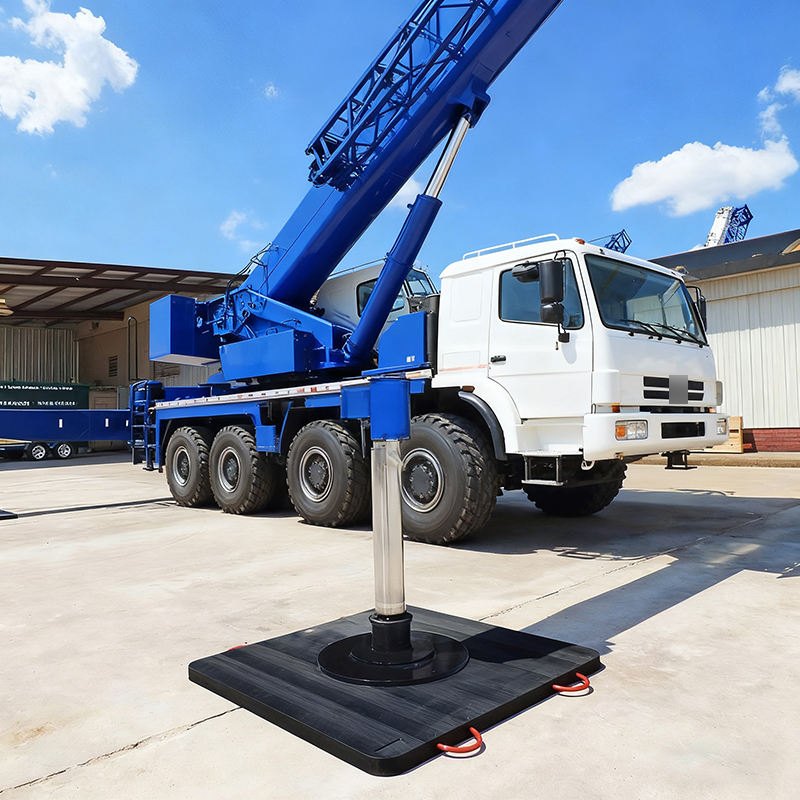
Standard UHMWPE Outrigger Pad — Every Size You Need
90% of outrigger pad orders fall into these standard square and round sizes. Square pads are the workhorse — more surface area, more load capacity. Round pads sacrifice a bit of area for portability: you roll them into position instead of lifting. Both are made from the same virgin UHMWPE, same anti-slip surface, and the same warranty terms. The only question is which size your crane needs.
Square Outrigger Pads — Standard Sizes
| Size (mm) | Thickness (mm) | Surface Area (m²) |
|---|---|---|
| 300×300 | 30-40 | 0.09 |
| 400×400 | 40 | 0.16 |
| 500×500 | 40-50 | 0.25 |
| 600×600 | 40-60 | 0.36 |
| 800×800 | 50-60 | 0.64 |
| 1000×1000 | 50-80 | 1.00 |
| 1200×1200 | 60-100 | 1.44 |
| 1500×1500 | 100 | 2.25 |
Load capacity depends on pad size, thickness, and ground conditions. Contact us for a size and thickness recommendation.
Round Outrigger Pads — Roll Into Position
| Diameter (mm) | Thickness (mm) |
|---|---|
| 800 | 50-60 |
| 900 | 50-60 |
| 1000 | 60-80 |
| 1200 | 60-80 |
| 1500 | 100 |
Load capacity depends on pad size, thickness, and ground conditions. Contact us for a recommendation.
Here's what most suppliers won't tell you: round pads have about 21% less surface area than a square pad of the same width. A 1000×1000mm square = 1.0 m². A 1000mm diameter round = 0.785 m². For the same ground bearing pressure, you need a larger diameter round. But the trade-off is worth it when one person can roll a 1200mm pad into position instead of needing a second worker to help carry a 1200mm square.
How to Select the Right Pad Size — Quick Math
Step 1: Find Your Outrigger Force
Formula: (Crane weight + Load weight + Rigging) × 0.65. Example: A 55-ton crane + 2.5T load + 0.5T rigging = 58T total. 58 × 0.65 = 37.7 tons per outrigger. This is the force one pad must handle.
Step 2: Know Your Ground
Firm clay: ~20 tons/m² bearing capacity. Compacted gravel: ~40 t/m². Asphalt: ~20 t/m². Soft/wet ground: <10 t/m². Always use the worst-case value — ground conditions change after rain.
Step 3: Calculate Required Area
Area = Outrigger Force ÷ Ground Capacity. For the 37.7T example on firm clay (20 t/m²): 37.7 ÷ 20 = 1.89 m². That means you need at least a 1400×1400mm pad. If you're on compacted gravel (40 t/m²): 37.7 ÷ 40 = 0.94 m². A 1000×1000mm pad (1.0 m²) works.
Pad Sizing Engineering — Verified Calculations & Advanced Load Distribution
Industry-standard formulas plus real-world ground bearing data. The calculations below replace vendor rule-of-thumb with verifiable engineering per Crane Industry Council guidelines.
Core Sizing Formula & Worked Example
Required Area = (0.65 × Total Weight) ÷ Allowable Ground Bearing Pressure. Example: 55t crane + 2.5t load + 0.5t rigging = 58t. 58 × 0.65 = 37.7t per outrigger on firm clay (20 t/m²). Area needed: 37.7 ÷ 20 = 1.89 m². A 1400×1400mm pad (1.96 m²) required. On compacted gravel (40 t/m²): 37.7 ÷ 40 = 0.94 m². A 1000×1000mm (1.0 m²) works.
Rule of Thumb — Pad-to-Shoe Ratio
Pad ≥ 3× outrigger shoe area on Grade A soil. This rule is conservative and derived from the same ground bearing equation using typical shoe dimensions (300–500mm diameter) and minimum allowable pressure assumptions. Always verify with actual ground bearing tests — a simple plate load test costs $500–1,000 and can justify a smaller pad size, saving thousands.
Ground Bearing Pressure Is NOT Uniform
Advanced modeling shows a 16-point pressure distribution under hydraulic outriggers, not the traditional 4-point assumption. Stiffness distributes load more than strength — a stiffer pad reduces peak ground pressure by 15–25% vs a same-sized flexible pad. This is why UHMWPE's higher flexural modulus (50–70 MPa vs HDPE 30–50 MPa) matters for crane stability, not just durability.
Need Help Sizing Your Outrigger Pads?
Send us your crane model and typical ground conditions. We'll calculate the right pad size and provide a quote within 24 hours.
Request a Quote