 Matunion
Crane Mats for Sale: Introduction
Crane mats for sale come in three purchase options: new mats in the standard specifications we routinely supply, mats made from recycled material, and custom mats made to a drawing. The options are not interchangeable. A new mat is priced against the size specification you approve; a recycled-material mat is priced against the condition and recycled content you must verify; a custom mat carries tooling, a minimum order and a longer lead time.
This guide is written by Matunion, which supplies HDPE and UHMWPE ground protection mats and UHMWPE outrigger pads. We do not supply timber crane mats. The timber and composite sections below therefore introduce categories you will meet from other suppliers. Where they are compared with the products we supply, we note the checks that matter. The aim is a like-for-like decision, not a catalogue.
Crane Mats for Sale: Types and Use Cases
A crane mat is a load-spreading platform placed under a crane, crawler track or heavy equipment to reduce ground pressure and bridge soft spots. The term is used broadly in the industry: some sellers mean a 12-inch bolted hardwood mat; others mean a 4×8 ft plastic mat; some mean an outrigger pad. Agree on the material before comparing quotes. Many listings for crane mats for sale describe only one of these categories, so the material has to be settled first.
Material options
Timber and hardwood crane mats. Hardwood crane mats are built from oak or mixed hardwood timbers bolted through with steel rods. Published supplier listings commonly describe a nominal 12-inch thickness and 4-foot width as standard, with lengths from about 16 to 40 feet; 8-inch mats are also offered. One published listing gives around 4,300 lb for a 4×16 ft, 12-inch hardwood mat; other listings give a lower weight, and actual weight varies with species, moisture and hardware. In addition, handling needs equipment and freight is weight-limited. Timber is stiff and widely used for crane hardstands, but it absorbs moisture, rots from the inside and loses section as timbers wear.
Composite crane mats. Composite crane mats are engineered from fiber-reinforced polymer or recycled composite. They are consistent, do not rot, and are lighter than timber for a comparable nominal section, which matters where crane time is expensive. Published capacities vary widely with construction, so compare the test basis and deflection data rather than the headline number. Composite usually costs more upfront than timber.
HDPE and UHMWPE crane mats. These are the mats Matunion supplies. The standard mat is 4×8 ft (1220×2440 mm), 12.7 mm thick, 38–42 kg, with double-sided diamond tread and six handholds; two workers can place one in under 60 seconds. They are ground protection and temporary road mats: they spread wheel and track loads over firm ground and interlock into a running surface. They are not a structural substitute for a 12-inch timber mat under a concentrated outrigger load.
The distinction matters commercially: a supplier who makes only one category may describe the others as unnecessary. The material should follow the duty — timber or engineered composite for a designed hardstand, thermoplastic mats for access and ground protection, and separate outrigger pads under outrigger floats.
Standard sizes and thickness
Crane mats sizes are not standardized across materials. Timber follows nominal inches and feet; thermoplastic mats follow sheet sizes; pads follow millimetres. Use the same units on every quote.
| Size (ft) | Dimensions (mm) | Area (m²) | Typical use |
|---|---|---|---|
| 4×8 | 1220×2440 | 2.98 | Site roads, crane hardstand surface, tracked plant |
| 3×8 | 915×2440 | 2.23 | Narrow access lanes, haul roads |
| 2×8 | 610×2440 | 1.49 | Pedestrian routes, light plant |
| 3×6 | 915×1830 | 1.67 | Confined access, utility works |
| 2×6 | 610×1830 | 1.12 | Small plant, event flooring |
| 2×4 | 610×1220 | 0.74 | Manual handling, tight spaces |
Matunion standard HDPE mat sizes; 12.7 mm is the standard thickness and custom sizes are available. Confirm thickness, pattern and weight for your load case.
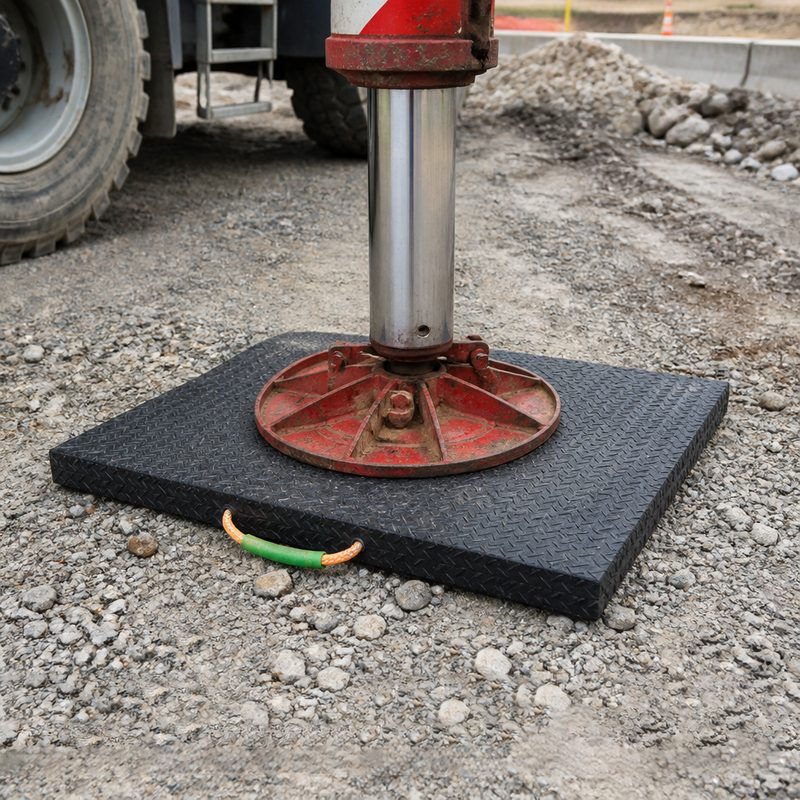
Outrigger pad sizes are a separate range: square pads from 300×300 mm to 1500×1500 mm, round pads from 800 mm to 1500 mm diameter, and thickness from 25 mm to 100 mm. Area runs from 0.09 m² to 2.25 m². A pad is sized by calculation, not by matching the mat.
Application fit
Use timber or engineered composite where the mat is part of the structural support for a crawler crane or a heavy hardstand, and have the arrangement designed for the actual track loads. Use HDPE or UHMWPE mats where the job is to protect ground, form a temporary road or create a clean running surface over a prepared base. Use UHMWPE outrigger pads under mobile crane outrigger floats and stabilizers. Crane outrigger pads are sized to the float and the calculated load; they are not a substitute for a mat under a track.
| Category | Typical form | Handling | Load basis to request | Typical fit | Watch-out |
|---|---|---|---|---|---|
| Timber / hardwood | Bolted hardwood, 8–12 in thick, 4–6 ft wide, 16–40 ft long | Crane or forklift; one published listing about 4,300 lb for a 4×16 ft, 12 in mat, others lower | Species, grade, moisture, bolt condition, design bearing | Crane hardstands, bridge decks, heavy haul | Rot, weight, freight cost |
| Composite | Engineered panels | Two-person or light plant | Test report, deflection, design load | Hardstands where rot and weight matter | Higher cost; variable published claims |
| HDPE / UHMWPE mats | 4×8 ft sheet, 12.7 mm standard | Two workers, under 60 seconds | Static load at thickness, size and ground | Temporary roads, ground protection, access | Not a structural timber replacement |
| UHMWPE outrigger pads | 300–2000 mm, 25–100 mm thick | One or two workers | Static load by size, thickness and ground | Outrigger and stabilizer floats | Size must be calculated, not guessed |
Load Rating and Ground Pressure
Static vs dynamic load
A static load is a steady load applied without motion. A dynamic load includes impact, travel, swinging, braking and vibration. A mat or pad rated for a static load has no reserve for dynamic effects unless the rating says so. Ask which basis the number uses before comparing two products.
Published planning multipliers used in our load calculator include 1.5 for lifting, 1.4 for swinging the boom, 1.3 for turning and 1.2 for braking. They are planning aids, not a substitute for the lift plan.
Allowable ground bearing pressure
| Ground type | Typical maximum permissible pressure (t/m²) |
|---|---|
| Hard rock | 200 |
| Shale and sandstone | 80 |
| Compacted gravel with up to 20% sand | 40 |
| Asphalt | 20 |
| Compacted sand | 20 |
| Stiff dry clay | 20 |
| Soft dry clay | 10 |
| Loose sand | 10 |
| Wet clay | Less than 10 |
CICA published guidance. Values are indicative estimates, not a site investigation. Use the allowable bearing pressure from a geotechnical assessment or plate load test for the actual lift; moisture, compaction and subsurface voids change the number.
Why tonnage claims are not comparable
A bare "100-ton mat" is not a specification. The number changes with the static or dynamic basis, thickness, size, ground condition, test method and safety factor. A thin HDPE ground mat and a thick outrigger pad are different products with different failure modes; their tonnage figures cannot be ranked against each other.
Matunion's product datasheet lists over 200 t static for its standard HDPE mats and over 600 t static for UHMWPE mats, on firm, competent ground, at the specified thickness and size. Those figures are not transferable to soft ground, a thinner sheet or a different size. Outrigger pads are listed from 10 t to over 100 t static across the range, again by size, thickness and ground condition. Ask every supplier for the basis in writing before you treat a number as a comparison.
Price Factors and Quote Comparison
Material, thickness and size
Crane mats price is driven first by material. In thermoplastic mats, virgin HDPE costs more than recycled or filled resin and behaves more consistently; the UV package, colour and surface pattern add cost. Thickness changes weight, load behaviour and freight. Size changes how many units fit in a container, which can matter more than the unit price on a large order.
Add-ons — handholds, connectors, engraving, serial numbers, custom colour and branded packaging — are small per unit and significant per fleet. Ask for them as separate lines so you can compare the base product.
Freight, duty and container loading
Ground mats are bulky and relatively light, so freight is usually volume-limited. For 12.7 mm HDPE mats, a 20 ft container typically holds 300–320 mats and a 40 ft container 550–580; confirm the loading plan for your thickness and size. Timber mats are weight-limited and may need flat-rack or breakbulk arrangements.
Duty and tax depend on the HS code, origin and destination. Confirm with your customs broker rather than accepting a supplier's landed-price estimate, which may exclude port charges, documentation or inland delivery.
What a complete quote should include
Matunion quotes FOB Qingdao, Tianjin, Shanghai or Ningbo, with CIF and DDP on request and EXW by agreement. Whatever the Incoterm, a quote you can compare should state the product specification, quantity, packaging, lead time, MOQ, payment terms, warranty and the test reports that apply. See our shipping and delivery terms.
| Quote line | Ask for in writing | Why it changes the comparison |
|---|---|---|
| Material and grade | Virgin or recycled, density or MFI, UV package | Same size can hide different resin |
| Thickness and tolerance | Nominal and measured thickness, tolerance | 10 mm and 12.7 mm are different products |
| Size and area | Millimetres and m², not only "4×8" | Area sets ground pressure |
| Pattern and finish | Pattern type and depth, both faces | Affects grip, weight and price |
| Hardware | Handles, connectors, pins, anchors | Frequently excluded from the unit price |
| Packaging | Pallets, strapping, edge protection | Affects damage rate and freight |
| Incoterm and port | FOB, CIF or DDP, with a named port | Allocates cost and risk |
| Freight basis | FCL or LCL, per container or per tonne | Volume-limited versus weight-limited |
| Lead time and MOQ | By item, in writing | Schedule and trial-order feasibility |
| Test reports | Report number, product, test item | Evidence, not a logo |
| Payment and warranty | Terms, claim process, exclusions | Cash flow and after-sales risk |
Buyer FAQ
Should I choose HDPE or UHMWPE mats?
Choose HDPE for general ground protection, temporary roads and access, where the standard HDPE mat meets the duty. Choose UHMWPE for outrigger pads and more demanding applications: Matunion lists HDPE mats at over 200 t static and UHMWPE mats at over 600 t static, on firm, competent ground at the tested thickness and size. Send us the load, ground condition and required size, and we will recommend the material and thickness.
What is the MOQ for HDPE and UHMWPE mats?
Matunion normally calculates MOQ by weight — about 2,000 kg per item — rather than by a fixed piece count. For example, 1220×2440×12.7 mm HDPE mats have an MOQ of 50 pieces. Custom sizes, patterns or colours start at 80 pieces or more, depending on tooling. We confirm the exact minimum in writing with the quote.
What is the lead time for standard and custom orders?
Standard stock ships within 15 days after deposit and approval. Custom production typically takes 15–25 days, and custom samples usually take 5–7 days. Peak season and Chinese New Year can extend these figures. We confirm the schedule in writing with the quote.
Can you customize the size, pattern, colour or logo?
Yes. We can supply custom sizes, tread patterns, colours and branded packaging, and we can add handholds, connectors, engraving and serial numbers. Custom sizes, patterns or colours start at 80 pieces or more, depending on tooling, and custom samples usually take 5–7 days. Send the drawing or specification and we will confirm the tooling, MOQ and lead time.
What is the MOQ for custom outrigger pads?
Matunion's typical minimum is 50 pieces for standard sizes and 80 pieces or more for custom sizes, patterns or colours, depending on tooling. Custom samples usually take 5–7 days; standard stock ships within 15 days after deposit and approval, and custom production typically takes 15–25 days. Peak season and Chinese New Year can extend these figures.
Next Step
Send us the crane model, outrigger float dimensions, ground condition and required pad size, and we will return a quote. You can also request a production sample or the current specification sheet. If you are comparing crane mats for sale, use the checklist above on timber, composite and plastic quotes alike; the questions apply to any crane mats supplier.
CTA: View outrigger pad sizes · Read the buying guide.
Reviewed by: Matunion Engineering Team
Last updated: 5 November 2026
How we researched this guide: We reviewed current published supplier listings for timber, composite and thermoplastic crane mats, CICA ground pressure guidance and OSHA 29 CFR 1926.1402 and 1926.1404. In addition, timber dimensions and weights are published listing examples, not Matunion specifications. Matunion product data comes from product datasheets and SGS reports; confirm the exact specification in writing before purchase.