 Matunion
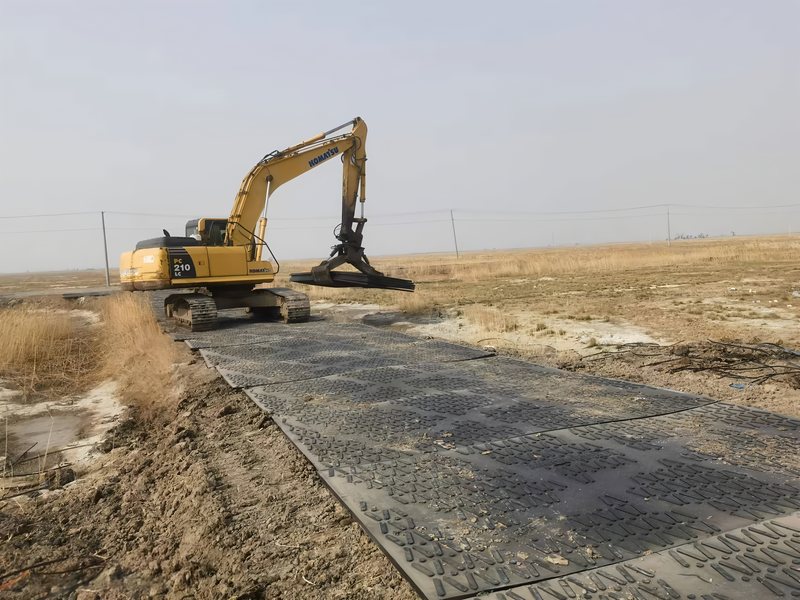
Buying construction mats for sale looks like a simple transaction: pick a size, agree a price, book a container. It is not. The same 4×8 ft footprint is sold as a 12.7 mm HDPE panel, a thicker UHMWPE panel, a moulded rubber slab, a composite panel or a hardwood crane mat. Two quotes are not comparable until material, thickness, size, load basis, connector system, packaging and delivery terms are on the same page.
Matunion supplies HDPE and UHMWPE ground protection mats. This guide compares the main mat types directly and is written for contractors, procurement managers and rental firms comparing construction mats supplier quotes.
The short version: fix the ground condition and the heaviest load first, then size and thickness, then quote terms. Price comes last, because a cheap mat that fails early is not cheap.
Construction Mats for Sale: Types and Use Cases
Construction mats for sale cover several product families that are marketed under interchangeable names: ground protection mats, access mats, road mats, temporary road mats and crane mats. The names describe the job, not the material. The material and thickness decide what the mat can actually carry.
Material options
HDPE ground protection mats. High-density polyethylene is the volume option for site access. Matunion's standard mat is virgin HDPE, UV-stabilised, 4×8 ft, 12.7 mm thick and 38–42 kg. It has a double-sided diamond tread, six handholds and an interlocking connector system, and two workers can place one in under 60 seconds. Polyethylene absorbs virtually no water, does not rot and is recyclable. Our website cites a 10+ year service life and 1,000+ reuse cycles rather than independently verified figures; treat them as typical values to confirm against your traffic and ground, not a guarantee.
UHMWPE mats. Ultra-high-molecular-weight polyethylene uses much longer polymer chains. The result is better wear resistance and, at its specified thickness, a higher static load: over 600 t static against over 200 t static for standard HDPE, per our client datasheet, on firm competent ground at the specified size. It is usually specified for tracked plant, repeated point loads, abrasive ground and cold climates rather than for general access. Our material comparison sets out the property differences in more detail.
Wood mats. Hardwood crane mats remain standard in parts of North America. They are heavy, need bolting or lifting equipment, absorb water and rot, and can carry phytosanitary or fumigation requirements in some markets when exported.
Rubber, composite and steel. Moulded rubber mats are common in turf protection and events. Composite panels are engineered for heavy construction and are usually sold with panel-specific load tables. Steel plates handle extreme short-duration point loads. Each has a job; none is a drop-in substitute at the same cost.
Standard sizes and thickness
Construction mats sizes run from 2×4 ft to 4×8 ft as standard, with custom sizes outside that range. The 4×8 ft mat is the default for plastic construction mats. It measures 1220×2440 mm and covers 2.98 m². Matunion also supplies 3×8, 2×8, 3×6, 2×6 and 2×4 ft mats, plus custom sizes, in black, white, blue, yellow, green or a custom colour.
Ground protection mat sizes are usually quoted in feet in North America and in millimetres elsewhere, which is one reason quotes get confused. Put both units in the specification.
Thickness is the second decision. 12.7 mm is the standard HDPE section. Heavier duty comes from a thicker section or from UHMWPE; the right combination depends on the load and the ground, so confirm the exact thickness-to-load pairing in writing.
| Mat type | Material | Common size | Thickness | Unit weight | Typical use |
|---|---|---|---|---|---|
| Standard duty | HDPE | 4×8 ft (1220×2440 mm) | 12.7 mm | 38–42 kg | Site access, vehicle and pedestrian crossings, turf protection |
| Heavy duty | UHMWPE | 4×8 ft and custom | Varies by specification | Varies with thickness | Tracked plant, point loads, abrasive or wet ground, cold climate |
| Wood (reference) | Hardwood | Varies | Varies | Varies | Traditional crane matting |
| Rubber (reference) | Recycled rubber | Varies | Varies | High for the footprint | Turf, events, pedestrian areas, light plant |
| Composite (reference) | Fibre-reinforced polymer | Varies | Varies | Medium | Panel-specific load data; heavy engineered projects |
Static load ratings are over 200 t for HDPE and over 600 t for UHMWPE, per our client datasheet. Both figures apply on firm, competent, drained ground and vary with thickness and size; confirm the exact rating for your specification in writing. They are not a universal rating for every mat we supply.
The table also shows why a "heavy duty construction mats" label means little on its own. Heavy duty for a rubber event mat and heavy duty for a UHMWPE access mat are different engineering claims.
Application fit
Match the mat to the job before comparing brands:
- Site access and haul routes. HDPE 4×8 ft mats in a two-mat width, connected, so the running surface stays together under traffic.
- Construction mats for heavy equipment. UHMWPE or thicker HDPE, specified against the machine's ground pressure rather than its gross weight.
- Pedestrian and light vehicle crossings. HDPE is usually enough; rubber where grip and comfort matter more than weight.
- Turf protection. HDPE or rubber, depending on whether the priority is load spreading or surface protection.
- Long-term outdoor storage yards. UV-stabilised HDPE or UHMWPE; avoid timber that will rot.
- Very heavy, short-duration crossings. Steel or a composite panel with a verified load table is often the right answer.
Connectors matter as much as panels. If you already own mats, ask whether the new connector is compatible. A mismatched system creates weak joints and slows every install.
Load Rating and Ground Pressure
Two mats can both be advertised at the same headline tonnage and behave differently on the same site. The number is only useful when the basis is stated.
Static vs dynamic load
A static rating assumes the load is stationary and evenly supported. A dynamic load includes travel, braking, turning, lifting and impact. The load ratings above are static, from our client datasheet, and apply only to firm competent ground at the specified thickness and size. Ask whether a quoted figure is a working load or an ultimate failure load, and for the test method behind it; without that basis, a tonnage is a marketing claim, not a specification.
On site, plant moves. Braking, turning and lifting all raise the effective load on the mat and on the ground beneath it. Our mat load calculator applies illustrative multipliers for these operations; use them for screening, then confirm with the machine manufacturer and a geotechnical assessment for critical work. Where mats support crane outriggers or crane travel, OSHA 1926.1402 requires the ground to be firm, drained and graded, and 1926.1404(q)(5) requires blocking to sustain the load and maintain stability.
Ground pressure formula: load ÷ contact area
The basic check is simple:
Ground pressure = load ÷ contact area
A 60 t load carried on four 4×8 ft mats covers 4 × 2.98 = 11.92 m², so the average pressure is about 5.0 t/m². That is arithmetic, not a rating. Real pressure is rarely even: a tracked machine concentrates load at the track ends when it turns, and an outrigger concentrates load on a small pad. Use the actual contact footprint — track area or pad area — not the full mat area, when the load is concentrated.
Compare the result with the allowable bearing pressure of the soil, not with the mat's tonnage claim. The mat spreads load; it does not create bearing capacity.
Price Factors and Quote Comparison
Several factors move the cost of a mat, and the same footprint can be made in different materials and weights, so a single list price would be misleading.
Material, thickness and size
Material grade is the first driver. Virgin HDPE typically costs more than recycled or filled resin, and the difference shows in consistency, UV life and how the mat behaves under load. UHMWPE costs more again. Ask for the material grade in writing: "HDPE" alone does not say whether the resin is virgin, recycled or filled.
Thickness is the second. A thicker sheet uses more resin and weighs more, which raises both product cost and freight. Size and pattern follow: a 4×8 ft mat uses more material than a 2×4 ft mat, and a deep tread or a custom pattern adds tooling and cycle time. Connectors, colour, UV package and a custom logo add cost at the margin. Volume has a large effect on unit price, which is why MOQ matters.
Freight, duty and container loading
Matunion ships FOB Qingdao, Shanghai or Ningbo, with CIF or DDP on request. Standard sizes typically ship within 15 days and custom sizes within 15–25 days, with a standard-size MOQ of 50 mats. Standard 4x8 ground protection mats are palletised and strapped for export, and container loading depends on thickness and the mix of sizes, so confirm the plan for your order.
Duty depends on the HS classification and destination; confirm the code and rate with your customs broker. Plastic mats are not wood, so ISPM-15 treatment does not apply to the mats themselves, but wooden pallets and crates in the shipment still need compliant marking. See our shipping and delivery notes for Incoterms and packaging.
What a complete quote should include
A comparable construction mats supplier quote puts the same fields in the same order. Use this table to normalize two or three quotes before you compare totals.
| Quote field | What to check | Risk if missing |
|---|---|---|
| Material grade | Virgin or recycled; UV package; datasheet | Recycled or filled resin sold as virgin |
| Dimensions and tolerance | Length, width, thickness, tolerance | Thin or undersized sheets |
| Unit weight | Weight per mat | Light mat sold at standard price |
| Load basis | Static/dynamic, size, ground, safety factor | Tonnage claim with no basis |
| Connectors | Type, number, compatibility | Weak joints; extra cost later |
| Packaging | Pallets, strapping, edge protection | Transit damage |
| MOQ and lead time | Written, by material and size | Schedule slip |
| Incoterm and port | FOB/CIF/DDP, named port, validity | Hidden freight and port charges |
| Payment and warranty | Deposit, balance, claim process | No remedy if mats fail |
| Test reports | Report number, product, test item | Certificate that does not cover your mat |
If a supplier will not complete this table, the price is not the problem.
Inspection and Acceptance
Sample vs bulk
Ask for a production sample, not a hand-made one. Confirm which line will make the bulk order and whether the sample came from it. A sample made on a different line, with a different resin or extra care, proves nothing about the container.
Ask the supplier to retain a production sample and to put batch numbers on the packing list. That gives you a reference if colour, thickness or surface changes later.
Dimensions, weight and surface
Measure the sample and, for container orders, the pre-shipment inspection lots:
- thickness at several points, especially the centre and edges;
- length, width and squareness;
- unit weight against the quotation;
- tread depth and pattern consistency on both faces;
- handholds and edge quality;
- connector fit, including against mats you already own;
- colour against the approved standard.
Most defects are visible before loading. A supplier that photographs and videos the inspection gives you evidence; one that "checks visually" gives you a promise.
Supplier Checklist
10 questions to ask
| # | Question | What a good answer looks like | Red flag |
|---|---|---|---|
| 1 | Who is the legal entity and where are the mats made? | Business licence, address, live video | Office only; no production site |
| 2 | Do you make the mats or resell them? | Clear answer; equipment list | No machinery |
| 3 | What exactly is the material? | Grade, virgin/recycled, UV package | "Plastic" or "high quality" |
| 4 | What is the load basis? | Static/dynamic, size, thickness, ground, safety factor | Bare tonnage |
| 5 | What sizes and thicknesses? | Written matrix and drawings | "Anything is possible" |
| 6 | Which test reports match this product? | Full PDF, matching model | Expired or mismatched report |
| 7 | How do you keep bulk consistent with the sample? | Batch records, retained sample | Sample from another line |
| 8 | What is the pre-shipment inspection? | Checklist, AQL, photos | "Visual check only" |
| 9 | MOQ, lead time and capacity? | Written, by size; capacity evidence | Verbal only |
| 10 | Incoterms, payment and warranty? | Written breakdown; claim process | Lump sum; full payment upfront |
Red flags
| Red flag | Why it matters | What to do |
|---|---|---|
| Price far below other quotes | Recycled or filled resin, thin sheet, or hidden freight | Ask for the material datasheet and weigh the mat |
| Report naming another company or product | No evidence for your order | Request a matching report or walk away |
| Payment to a personal or unrelated account | Weak legal recourse | Require the account to match the contract |
Buyer FAQ
How long do ground protection mats last?
Our website cites a 10+ year service life and 1,000+ reuse cycles for HDPE mats; these are not independently verified test figures. Real life depends on traffic weight, ground abrasiveness, UV exposure, handling and storage. Mats dragged over sharp rock or left in direct sun on a hot yard will not reach the upper figure. A realistic plan is to inspect annually, track breakages and compare replacement cost against the purchase price.
How do you clean and store ground protection mats?
Hose or pressure-wash off mud and aggregate before stacking, because grit trapped between mats abrades the tread. Store flat or on edge in a rack, out of sustained direct sun where practical, and away from heat sources. Do not stack heavy items on mats in storage. Our maintenance guide covers cleaning, inspection and repair in detail.
How much do ground protection mats cost?
Construction mats price is driven by material grade, thickness, size, connectors, order volume and freight. We do not publish a price list because a 4×8 ft mat can be made in several specifications, and the delivered cost depends on the Incoterm and destination. Ask for a quote that states the material grade, dimensions, unit weight, load basis and Incoterm, then compare quotes on those fields rather than on the headline number.
What size ground protection mat do I need?
Start with the heaviest load and its contact footprint, then the ground condition, then the number of mats needed to spread that load to an acceptable pressure. The 4×8 ft mat is the default for site access; for a haul route, two mats side by side give an 8 ft running width. Construction mats sizes are usually quoted in feet in North America and millimetres elsewhere, so convert before comparing. Use the load calculator for a first estimate and confirm critical cases with an engineer.
How many 4x8 mats fit in a 40ft container?
For 12.7 mm HDPE, a 40ft container typically holds about 550–580 mats, and a 20ft about 300–320. Many customers mix sizes to fill a container, so treat these counts as a reference. Thicker or heavier mats reduce the count because the container reaches its weight limit before the floor area is full. Confirm the loading plan for your exact sizes.
Next Step
Send us the ground condition, the heaviest machine and the running width you need. We will come back with a specification, a production sample offer and a quote in the same format as the table above, so you can compare it with any other quote field by field.
CTA: Request a same-basis quote · Request a production sample · Download the selection table.
Reviewed by: Matunion Engineering Team
Last updated: 5 November 2026
How we researched this guide: We reviewed current supplier listings, official ground-condition requirements and our own product data and test reports. Load figures are static ratings on firm competent ground for a defined thickness and size, not universal capacities. Confirm the exact specification in writing before purchase.